Superman and the New DC Movie Universe
James Gunn’s new universe takes its cues from the comics, and it’s all the better for it.

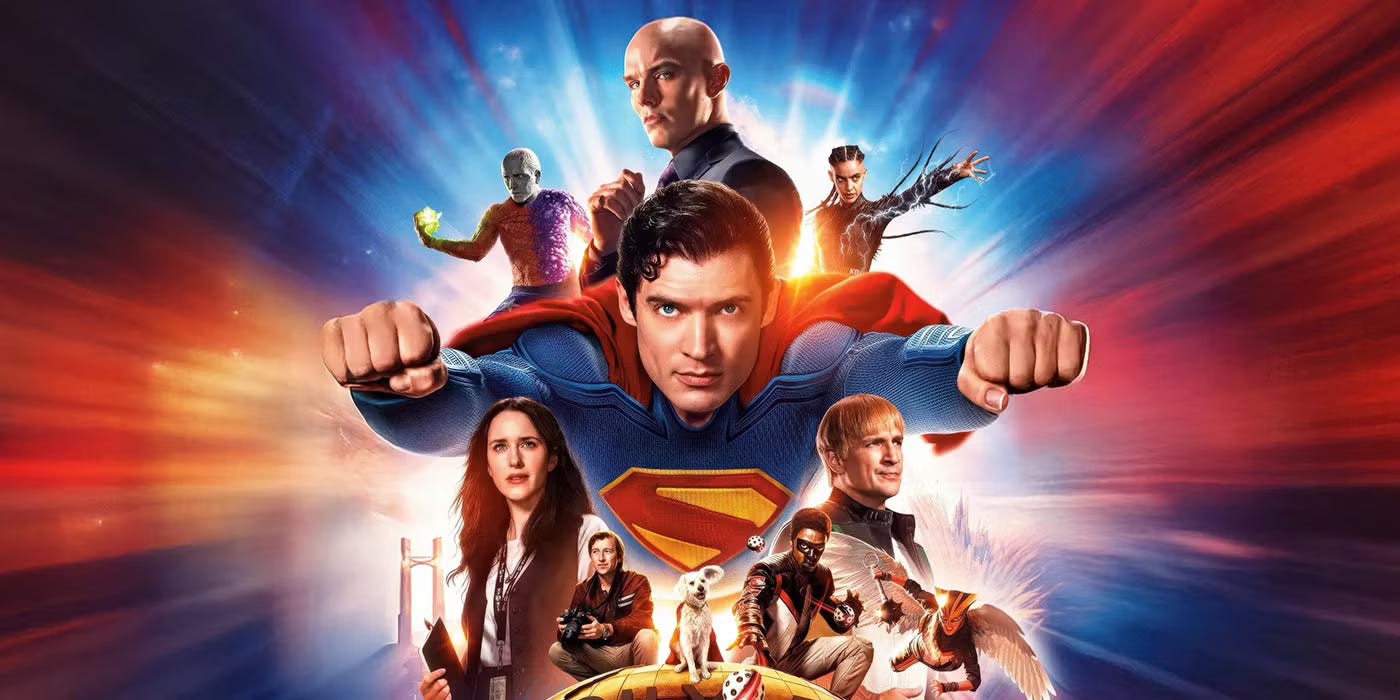
In 1978, I was ten years old when I watched Superman the Movie. While it wasn’t quite the revelatory experience of the previous year’s Star Wars, it made an impression. I had read several years of Superman comics by then and knew the character pretty well already.
Of course, I’d seen the black and white Superman with George Reeves winking at the camera and jumping out of windows to fly. I grew up with the Super Friends, and I remember watching the Fleischer cartoons in a darkened comic book convention hotel ballroom right around the same time. Superman was a permanent fixture in my household.
I religiously watched the Adam West Batman show of the 1960s in reruns. I didn’t care that it was camp, and I didn’t even understand what that was. To me, it was simply a live-action comic book. That’s all that mattered.
Superman the Movie was about as close to a live-action comic book as there ever was up to that time.
As I got older, I wanted my comics and my comic book movies to be more sophisticated. I wanted more realism in my superheroes. The Silver Age comic book style felt dated and silly. All the super science and weird creatures didn’t work anymore.
Anti-heroes like Wolverine and Rorschach appealed to me. Characters like James O’Barr’s The Crow and Howard Chaykin’s American Flagg! series were modern, anti-establishment, and real.
To avoid any comparisons with the Adam West TV show, the first Batman movie with Michael Keaton pushed the character into darkness and a little psychosis. I mean, a rich guy dressing up like a bat to beat up criminals? He had to be a little bit crazy, right?
Christopher Nolan’s Batman trilogy leaned even more toward realism.
While the Marvel movies have a strong science fiction and fantasy aspect to them, the heroes are all mostly grounded in the real world.
James Gunn’s Superman, however, represents a masterclass in how to establish a sprawling universe while maintaining narrative focus. Gunn chose not to overwhelm viewers with exposition or teasers about what’s to come but simply created a world so rich and lived-in that audiences naturally want to explore its furthest corners.
Gunn’s DCU is not the real world. It’s the world of the comics. More specifically, the Silver Age of DC Comics. And that’s something new. Thank goodness. It was about time audiences were presented with superheroes in a less-than-real-world setting.
As I’ve gotten older, I’ve come full circle on the super science and silliness of the Silver Age. Maybe it’s just a backlash against the modern superhero movie or even modern-day life. In any case, giant kaiju in Metropolis could not be more Silver Age1, and I’m here for it.
Rather than painstakingly explaining how ‘Gods and Monsters’ came to populate this world, the film drops audiences directly into the middle of ongoing conflicts, treating superpowered beings as facts of life rather than shocking revelations.
It’s organic worldbuilding that feels authentic. While the original Star Wars movie in 1977 did not have the Episode IV: A New Hope title (added in the 1981 rerelease), The Empire Strikes Back did have the Episode V title. Star Wars drops audiences into the action in the middle of the story, just like with Superman. Part of the fun of Star Wars back then was using your imagination to fill in the gaps. We didn’t know what the Clone Wars were or what Jedi Knights did back before the Empire. Comic book fans might have a clue who Mister Terrific is, but the average moviegoer does not, and that’s exciting from a narrative point of view.
The film’s opening with Superman bloodied and beaten in the Arctic tells audiences that this isn’t an origin story, but rather a chapter in an ongoing saga. We don’t start with baby Kal-El, his parents, Krypton exploding, and him landing in Kansas. Gunn, rightly, realized there was no need to show it again. First off, almost everyone knows the basics of the Superman origin, so why bog the story down? Secondly, doing it this way, audiences understand they’ve entered a story already in progress, yet rather than feeling lost, contextual clues compel them to piece together the larger tapestry.
The genius of Gunn’s approach lies in his fundamental understanding that effective universe-building isn’t about showing everything. It’s about suggesting infinite possibilities just beyond the frame. He sets his new DCU in a completely fictional world that sort of resembles our own, but isn’t. Gunn has said there’s no New York City or Los Angeles on this Earth. The countries are different, and the corporations that dominate the culture aren’t the ones we might think of here in the real world.
One interesting angle about using this approach is how it treats supporting characters not as cameos or future movie previews, but as important elements of the current story who happen to have fascinating depths left unexplored. The Justice Gang (that name is a work in progress) members, Isabela Merced’s Hawkgirl, Nathan Fillion’s Green Lantern, and Edi Gathegi’s scene-stealing Mister Terrific, aren’t merely future franchise stars making appearances. They’re characters with distinct personalities, clear relationships to Superman, and their own interesting interpersonal dynamics that naturally make audiences curious about their individual stories. There’s a lot of buzz already about a Mister Terrific TV show.
This integration extends to the film’s handling of its broader mythology. Rather than pausing the narrative to deliver information dumps about this world’s history, Gunn weaves exposition into action and character interactions. The scene of Lois interviewing Clark/Superman provides the audience with a wealth of information in an entertaining way and also shows the interaction (and chemistry) between the two characters.
The romantic relationship between Clark and Lois serves as a particularly effective microcosm of the film’s approach. Their dynamic isn’t just about two people falling in love. It’s also about how relationships function in a world where one partner can level buildings and the other regularly investigates global conspiracies. Their chemistry makes audiences invested in their personal story while simultaneously illustrating larger themes about trust, identity, and normalcy in an extraordinary world.
Their conversation about geopolitical complexities surrounding Superman’s intervention in foreign conflicts doesn’t feel like an artificial plot device, but like a natural consequence of a world where a superpowered being operates on a global scale.
Additionally, the movie raises questions that extend far beyond the immediate plot. How do governments actually respond to metahumans? What are the diplomatic ramifications of superhero intervention? How does society function when godlike beings walk among mortals?
The film’s treatment of Lex Luthor showcases this sophisticated approach to universe-building. Rather than simply presenting him as a megalomaniacal villain, the film positions the character as a tech billionaire with tentacles extending into government, industry, and international affairs. This suggests a complex web of corruption and influence that could sustain multiple storylines across different media. His manipulation of global conflicts and social media campaigns against Superman creates a sense that his influence extends far beyond what we see in the immediate story, hinting at a vast network of operations that could be explored in future installments.
While it’s fun to think about how Luthorcorp can be an overarching threat in the DCU, I’m looking forward to a more hands-on approach to the character down the line. For example, I can’t wait to see Lex in his green and purple powered armor.
Before seeing the movie, I was worried that there were far too many characters involved. I should not have been concerned. Gunn’s goal was not only to tell a great Superman story, but also to establish this new DC movie universe. He manages to establish the universe without relegating Superman to supporting player status in his own story. Every subplot, every supporting character, every worldbuilding detail ultimately serves to illuminate different aspects of Superman’s character and challenges. The presence of other heroes doesn’t diminish Superman’s importance. What Gunn did was use the other characters to set up his unique position in this world and highlight what makes him special among the “metahumans.”
Gunn’s background with ensemble casts serves him particularly well here. His experience balancing multiple characters in Marvel’s Guardians of the Galaxy movies translates seamlessly to this larger canvas, where each supporting character feels distinct and purposeful. The chemistry between characters suggests relationships with histories that extend beyond what the audience sees on screen, creating the sense that these people have rich lives and interactions that continue when the camera isn’t focused on them.
The film’s handling of Superman’s internal conflicts adds another layer to its universe-building strategy. By presenting a hero grappling with questions about his role and purpose, the story naturally opens discussions about power, responsibility, and identity. Superman’s speech to Lex Luthor illustrates the point perfectly. It is the strongest line in the entire movie and showcases Gunn’s command of the character.
Throughout the movie, the script reinforces the idea of an active universe. The bright, colorful aesthetic doesn’t just represent a stylistic choice. It signals to audiences that this world is fundamentally hopeful and worth exploring. Unlike the muted palettes that often characterize “realistic” superhero films (see the Snyderverse), this vibrant approach suggests a universe where wonder and possibility haven’t been suffocated by cynicism. It’s a world that looks fun to inhabit, not just observe.
What truly distinguishes this approach to universe-building is its confidence. Rather than painstakingly explaining every detail or justifying its choices, the film presents its world with the assurance that audiences will accept and embrace it. When filmmakers trust their audience’s intelligence and imagination, viewers respond by becoming more engaged and invested. That’s what happened with Everything Everywhere All At Once, Star Wars, John Wick, The Matrix, and so many others.
The result is a film that functions perfectly as a standalone story while simultaneously laying groundwork for countless future adventures. Audiences leave the theater satisfied with the complete narrative they’ve just experienced, yet want to learn more about the characters and situations that populated its margins. It’s the difference between a commercial that advertises future products and a compelling story that makes you wish you could live in its world.
Gunn’s Superman demonstrates that the most effective universe-building happens when creators focus on crafting a single, exceptional story populated with rich characters and genuine conflicts. By trusting audiences to connect dots and fill in the blanks, the film creates a sense of discovery and possibility that makes the larger universe feel alive and worth exploring, just like opening a random issue of a Superman comic.
In the end, Gunn’s Superman succeeds because it remembers that universes are built from stories worth telling and characters worth knowing. By creating a world that feels both complete and infinite, it achieves the holy grail of franchise filmmaking: making audiences desperate to return not because they have to, but because they genuinely want to.
Be seeing you.

KISSed in Cadillac
KISSed in Cadillac reveals the incredible true story of how rock legends KISS transformed a small Michigan town forever in 1975. What began as a school spirit boost became a historic homecoming show that rocked Cadillac to its core. This electrifying documentary captures firsthand accounts from organizers, fans, and community members celebrating their town's legendary rock-and-roll moment. Can you imagine any other band doing something like this? I didn’t think so. RELATED: Years ago, I paid big money for a VHS bootleg of the entire KISS Unplugged performance with outtakes, false starts, and more. Now, it’s just on YouTube. Sigh.
‘I went from world champ to mopping floors’: Colin Cummings, the greatest air hockey player of all time
This is just a fun story about the greatest air hockey player in the world. One of my favorite pastimes is finding stories about champions in areas that most people never realize there’s a professional rank.
MAGA World Is So Close to Getting It
Tom Nichols on the Gavin Newsom trolling of Donald Trump on social media: “I suspect—as I have since the day Trump announced his first run for president a decade ago—that the MAGA faithful are hypersensitive to criticisms of Trump because, in their hearts, many of them know. They know that many of Trump’s statements are offensive and alarmingly detached from reality. They know that Trump has a disordered personality. They know that the president is a daily embarrassment to his party and to his nation.” I’d like to think so, but I’m still not sure.
MSNBC Will Change Name to MS NOW After NBCUniversal Split
Shockingly bad in every conceivable way. Whoever thought “My Source for News, Opinion, and the World” was good should be fired. The entire design and creative team should be fired. The web domain msnow.com is registered in Gyeonggi, South Korea by someone who is clearly not trying to produce news content. How can you pick a name without a corresponding URL? I’m not even going to mention the Austrian flag graphic that’s been added to the logo. Whoops. I just did. What a joke.
Celebrating 50 years of The Rocky Horror Picture Show
Get ready to do the Time Warp again! The Rocky Horror Picture Show celebrates its gloriously amazing 50th anniversary. I actually heard the music first before I ever saw the movie. Don’t dream it… be it!
Well, What Did You Think Would Happen?
This is exactly what I thought would happen. Putin would get his photo, legitimizing his criminal and corrupt regime. Trump would look like a weak lackey. There was never going to be a deal hashed out.
Joe Caroff, Designer of the James Bond 007 Logo, Dies at 103
Originally created for simple stationery letterhead, the iconic 007-gun design didn't become the franchise's primary symbol until On Her Majesty's Secret Service. I always thought the original logo gun resembled a German Luger—not Bond's actual Walther PPK. Designers fixed it for The Living Daylights. The good trivia? Caroff was paid $300 and never received another dime.
College Sports Has a Brand-New Villain
Will Leitch frames the new landscape of college athletics as Us (Big Ten, SEC) vs Them (everybody else). He’s not wrong. The NCAA has been neutered. The real power lies with those who have the best television deal. Guess what? It’s the Big Ten. College football is college athletics, and the conferences with the most money, the most talent, and the most audience will win. So, sorry ACC, Big 12, etc., you are going to become irrelevant. Also, Will’s history of responsible drinking is an interesting read.
Good Ideas Will Save the Country
Scott Galloway turns his blog over to his research lead, Mia Silverio, who writes about storytelling and how that is the most important skill successful people use.
Read Tony Gilroy's Original 'Andor' Season 2 Pitch
Look, I understand that Star Wars fans are a bit divided on Andor. Those who don’t like it because it eschews all the traditional trappings of Star Wars, like lightsabers, space battles, cackling emperors, sassy droids, and the Force, have a point. I think they are wrong and need to stop being man-children, but to each their own. Andor is serious science fiction accurately describing a real rebellion of sacrifice, spycraft, and hidden agendas. The two seasons of Andor coupled with Rogue One are the best Star Wars stories. You may not like them, but you are wrong. Also, Tony Gilroy is sad at how relevant Andor has become. Want more? Read the post-final production script for Andor season 2 episode 9, “Welcome to the Rebellion”, by Dan Gilroy here and relish the writing.