Winterset Hollow Is Perfect October Reading
What would you do if your favorite childhood story turned out to be real?
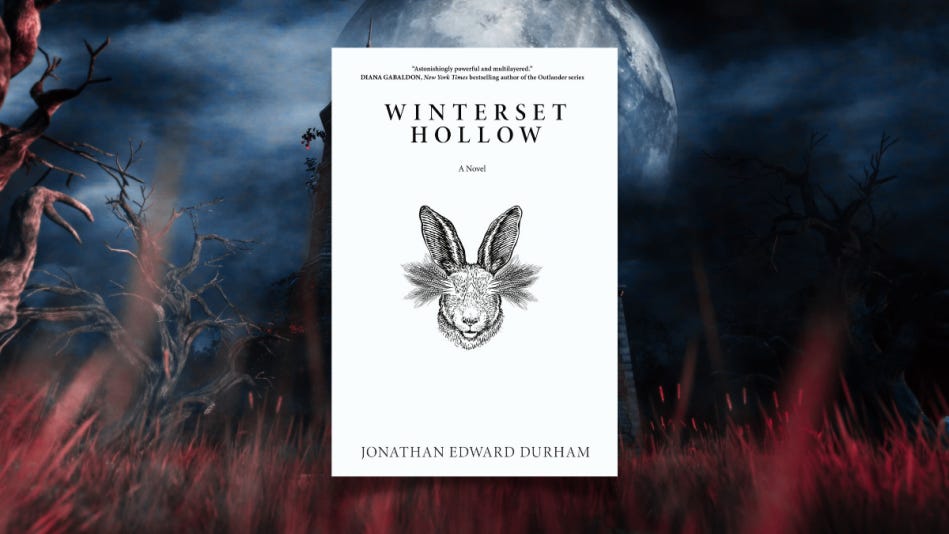
October is in full swing, and I’ve been thinking about the kind of horror that I like. I never cared for movie jump scares or much of Stephen King’s output. The first horror movie I ever saw was Friday the 13th, and I didn’t really like it. Horror, as a genre, just wasn’t something for me.
The horror concept that gets me most excited is taking something you loved as a kid and peeling back the layers to reveal something weirder or darker. Jonathan Edward Durham’s Winterset Hollow does precisely that, and it’s the perfect book to read this Halloween season.
I picked up Durham’s book because of his online presence on Bluesky. He’s funny, intelligent, and engaging. He has a Substack account where he writes about his life and occasionally shares short stories. I read a few and decided I needed to read more.
While I’m not a horror book or movie guy at all, I thought the premise of his book was too good not to give it a try: What if your favorite childhood story turned out to be real?
We all grew up with stories about talking animals. Maybe you loved Alice’s Adventures in Wonderland, Winnie the Pooh, or The Wind in the Willows. Maybe you watched The Secret of NIMH or Watership Down. These stories felt scary, but safe. A rabbit could be brave without being frightening. A fox could be clever without being dangerous. The anthropomorphic characters taught us lessons about friendship and courage while keeping us at a comfortable distance from anything too real.
Durham understands the line between safe and scary. He knows exactly why we loved those stories, and that’s why he knows exactly how to turn the brightness of the stories we know all too well into absolute horrific circumstances.
Winterset Hollow is exceedingly clever. Inside Durham’s novel sits another book, also called Winterset Hollow. This in-story book is a beloved children’s classic about rabbits, foxes, frogs, and bears celebrating their annual harvest festival called Barley Day. Our main character, Eamon, clung to this book during a terrible childhood. For him, it wasn’t just entertainment. The book was his survival mechanism. It was the one place that felt safe when nothing else did.
Yes, this does parallel Lev Grossman’s The Magicians, which is sort of “What if Harry Potter and The Chronicles of Narnia were real?” However, that’s where the comparisons end.
The novel follows Eamon and his two friends, Mark and Caroline, as they make a pilgrimage to the island where the book was written. They want to celebrate Barley Day in the place that inspired their favorite story. It’s the kind of fan trip people dream about. Walking where your favorite writer walked and getting a peek at the magic behind the curtain.
After they arrive on the island, they discover the characters from the book are real.
Not actors in costumes. Not animatronics. Real living creatures who have been on the island for decades. Eamon and his friends meet the characters from their favorite book, including the prim and proper Runnymede Rabbit, the gourmet cook Flackwell Frog, the sharp and clever Phineas Fox, and the sullen and massive Binghamton Bear.
Their initial reaction is pure joy. The childhood fantasy becomes reality. Imagine if you walked into a house and found your favorite fictional characters sitting at the dinner table. You’d want to join them, talk with them, and enjoy their company. You’d be ecstatic.
Here’s where Durham springs his trap.
Durham takes the core traits that made these animal characters appealing and removes all the guardrails. Runnymede Rabbit still represents vulnerability and perseverance. However, now that vulnerability comes with decades of actual pain. Phineas Fox is still clever, but there’s bitterness too. These aren’t corrupted versions of familiar archetypes. They’re what those archetypes become when they’re freed from the constraints of children’s literature.
As a reader, we understand these kinds of children’s stories. We grew up with them. They shaped how we see the world. Durham takes that trust and shows us what we’ve been ignoring. The lived reality of these anthropomorphic characters is anything but wholesome.
Talking animals have a long tradition of serving as metaphors for broader perspectives. George Orwell used pigs to explore the concept of totalitarianism. Watership Down depicted violence and death through the eyes of rabbits. Still, those stories followed unwritten rules.
Winterset Hollow asks: What if there weren’t any rules?
The Winterset Hollow within Winterset Hollow is a whimsical story about innocence lost, survival, and resistance. Durham includes excerpts from the fictional children’s book throughout. Each idyllic verse about Barley Day sits alongside scenes of escalating violence. The juxtaposition is jarring on purpose.
The horror isn’t that these beloved characters commit violence. The horror is that their violence makes perfect sense. Once you understand what they’ve survived, and you see the whole picture instead of the sanitized version, the gap between cute storybook animal and vengeful creature shrinks to nothing. Durham delights in explaining the motivations of the animal characters and the consequences that befall the island’s visitors. As a reader, you may even find some sympathy for the anthropomorphic characters. I know I did.
Halloween stories are often about confronting what scares us. However, for me, the best horror doesn’t come from scary monsters or killers in masks. It comes from taking something familiar and revealing its true nature. Winterset Hollow is both a story of survival and a metaphorical tale about inhumanity.
Want to learn more? The answers await on Addington Isle, where Barley Day means something very different from what the children’s book told you.
Be seeing you.

Atari Brings Back Intellivision Console for Its 45th Anniversary
Growing up, we had an Intellivision, not an Atari 2600. My brother and I loved it and played it constantly. Atari acquired the Intellivision brand, along with most of its game catalog, last year and is now bringing it back as the Intellivision Sprint. It has 45 built-in games. “Sprint has an authentic design, with the classic gold and black surface and wood grain front. Some of the new technical upgrades include two wireless controllers, HDMI output, and a USB-A port for library expansion.” It costs $149.99 and will ship on December 5, 2025, just in time for the holiday season. Man, I kinda want one.
Shohei Ohtani just played the greatest game in baseball history
“This is Beethoven at a piano. This is Shakespeare with a quill. This is Michael Jordan in the Finals. This is Tiger Woods in Sunday red. This is too good to be true with no reason to doubt it. This is the beginning of every baseball conversation and the end of the debate: Shohei Ohtani is the best baseball player who has ever played the game.” I watched a bit of this game. Incredible.
Things I’ve learned at 55 of age, going blind and seeing too many mates dying too soon.
Rob Campbell is not having a good day. On the other hand, it has motivated him to create something pretty amazing. His creative output is better than good. It’s great. Highly recommended.
I Apologize, Absolute Batman. I Wasn’t Familiar With Your Game
“Absolute Batman, written by Scott Snyder and drawn by Nick Dragotta with colors by Frank Martin, strips Bruce Wayne of his usual hallmarks. No mansion. No generational wealth infinite money glitch. No philanthrocapitalist posturing. He’s arguably the most on-the-ground version of Bruce Wayne I’ve ever seen: a blue-collar collar engineer. Instead of one central hub that gets more comedic with every trophy he adds to his man cave, he sets up a network of safehouses in abandoned construction projects. He’s tapped in as Bruce Wayne, listening to the city’s pulse from the ground up and acting as a seismic earthquake, reshaping Gotham to the people’s needs. Meanwhile, Batman is bigger, scrappier, hungrier, and as tame as a rabid dog. Yet in that rough, visceral outline of his still-recognizable silhouette is a heart that feels more Batman than most Batman media I’ve experienced.” Sigh. I suppose I’ll have to see if this lives up to the hype.
The White House Lied About Destroying the White House
I hate this so much. Drew Magary regarding the destruction, “When you elect Trump as president, as Americans have now done twice over, you’re voting FOR desecration.” From the Wall Street Journal: “The Treasury Department instructed employees not to share photos of the demolition of parts of the White House’s East Wing after images of construction equipment dismantling the facade of the building went viral online.” It’s a pile of rubble now.
Philip Pullman’s Anti-Escapist Fantasy
Lev Grossman pens a wonderful review of the latest book from Phillip Pullman and, consequently, analyzes the entire Book of Dust series, the previous His Dark Materials series, and explains how his writing, while influenced by Tolkien and Lewis, is nothing like them at all.
The Neurodivergent Genius Who Invented Formula 1 For Marbles
“Marble racing has become a viral sport on YouTube, drawing millions of fans to intense marble league tournaments, high-speed marble runs, and oddly satisfying competitions. Jelle’s Marble Runs is the world’s most popular marble racing channel, created by Jelle Bakker, an autistic YouTuber whose precision and creativity turned a childhood hobby into a global sensation. With detailed marble tracks, live-style commentary, and fan-favorite teams like the Savage Speeders and O’rangers, Jelle built a competitive league that rivals traditional sports in passion and fandom. This is the story of how one creator on the autism spectrum redefined online sports through marbles, community, and viral spectacle.” I love this so, so much.
Where Are the Aliens? New Study Suggests They’re Stuck Like Us
“This idea, known as the radical mundanity principle, suggests that alien societies aren’t building massive space structures or traveling at light speed. Instead, they’re probably a lot like us—and just as limited in their ability to find others in the galaxy. And they stay that way, eventually losing interest in cosmic exploration over time.” That’s an elegant answer. I hate it, but I get it.
Here’s some free advice: embrace cringe
John DeVore is a writer I admire, and this piece resonates with me.
What Job Is A Guy With A Nazi Tattoo Qualified For?
David Roth, writing for Defector, has a smart piece regarding oyster farmer and novice politician Graham Platner, and his recently revealed Nazi Totenkopf visibly tattooed on his chest. “Do you want a candidate who supports genocide or one with a Nazi tattoo on his chest? is not only a question that will continue to be asked earnestly by people who previously rejected demands for such compromises, but one that cannot be answered without submitting to some amount of humiliation. All of it, in the end, becomes a question of what you will settle for, and how much you are willing to bear in exchange for a chance at making things less unbearable.” Platner has since had the tattoo covered up. Seriously, Graham Plattner is kind of a disaster, but Democrats need more candidates like him. Just not exactly like him.